
Key Takeaways:
- Ladderway openings must be protected with compliant fall protection systems, such as self-closing safety gates, to meet OSHA and ANSI standards.
- Ladderway openings are a serious fall hazard – Unprotected ladder access points increase the risk of workplace injuries, OSHA violations and costly downtime.
- Temporary barriers aren’t OSHA-compliant, and chains and removable barriers provide inconsistent protection and should be replaced with permanent safety solutions.
- Self-closing gates improve safety and access – Ladder safety gates help maintain OSHA compliance while allowing safe, efficient access to elevated work areas.
In industrial and manufacturing facilities, ladderways provide critical access to elevated workspaces, mezzanines, platforms, maintenance areas and production systems. Employees use these access points throughout the day, often while checking inventory, inspecting equipment or performing time-sensitive maintenance tasks.
Unfortunately, ladderway openings also represent one of the most overlooked fall hazards in industrial environments. OSHA (Occupational Safety and Health Administration) and ANSI (American National Standards Institute) regulations specifically address these risks because falls from elevated surfaces continue to be among the leading causes of workplace injuries across manufacturing and industrial operations. The challenge for leadership and safety professionals is creating an environment where workers remain protected without resulting in too much negative impact on productivity or creating operational bottlenecks.
The Facts:
OSHA regulations governing walking-working surfaces and fixed ladders establish clear requirements for protecting ladderway openings in industrial settings. Under OSHA 1910.29(b)(13), any guardrail opening used as a ladderway access point must either:
- Include a self-closing gate that swings or slides away from the opening
- Be offset so that employees cannot accidentally walk into the opening
These standards are intended to eliminate unprotected edges and reduce the risk of falls around elevated work areas.
ANSI standards further reinforce safe ladder design and access requirements. ANSI A14.3-2008 specifically addresses fixed ladders used in industrial and commercial environments, including recommendations for ladder dimensions, climbing clearances, landing platforms and associated safety systems.
The Challenge:
In short, facilities cannot rely on temporary chains, removable barriers or inconsistent safety practices where permanent protection is required. These outdated methods of protecting ladder openings not only lack reliability, they can inadvertently encourage workers to bypass safety systems entirely. On the other hand, employees still need fast and reliable access to elevated areas in order to maintain production efficiency, complete inspections, perform maintenance and troubleshoot equipment issues.
At the same time, OSHA continues to place responsibility on employers to provide compliant fall protection systems and maintain safe walking-working surfaces. Failure to properly protect ladderway openings can result in citations, worker injuries, operational downtime and increased liability exposure.
OSHA 1910.29 — Guardrail And Ladderway Opening Requirements
OSHA 1910.29 establishes the criteria and practices for fall protection systems used in general industry settings. The regulation specifically addresses ladderway openings and states that any guardrail opening serving as a ladder access point must have:
- A self-closing gate that swings or slides away from the opening, and
- Top rail and midrail protection that meets OSHA guardrail requirements.
OSHA 1926.1053 – Ladder Safety Requirements
OSHA 1926.1053 outlines safety requirements related to portable and fixed ladders used in industrial and construction environments. The standard addresses:
- Ladder structural capacity
- Proper ladder usage
- Climbing safety
- Ladder positioning
- Safe access and egress practices
While many facilities focus heavily on ladder construction itself, OSHA also expects employers to manage the hazards surrounding ladder access points – including elevated openings and transition areas. Similarly, ANSI standards also address the dangers of fixed ladders with unsecured ladderways. These ANSI standards are widely recognized throughout industry and are often used to supplement OSHA compliance efforts with additional best practices for worker protection.
ANSI A14.3-2008 – Fixed Ladder Standards
ANSI A14.3-2008 provides detailed guidance for fixed ladder systems commonly used in industrial and manufacturing facilities. The standard includes recommendations related to:
- Ladder dimensions and geometry
- Landing platforms
- Climbing clearances
- Fall protection integration
- Ladder access safety
The Solution:
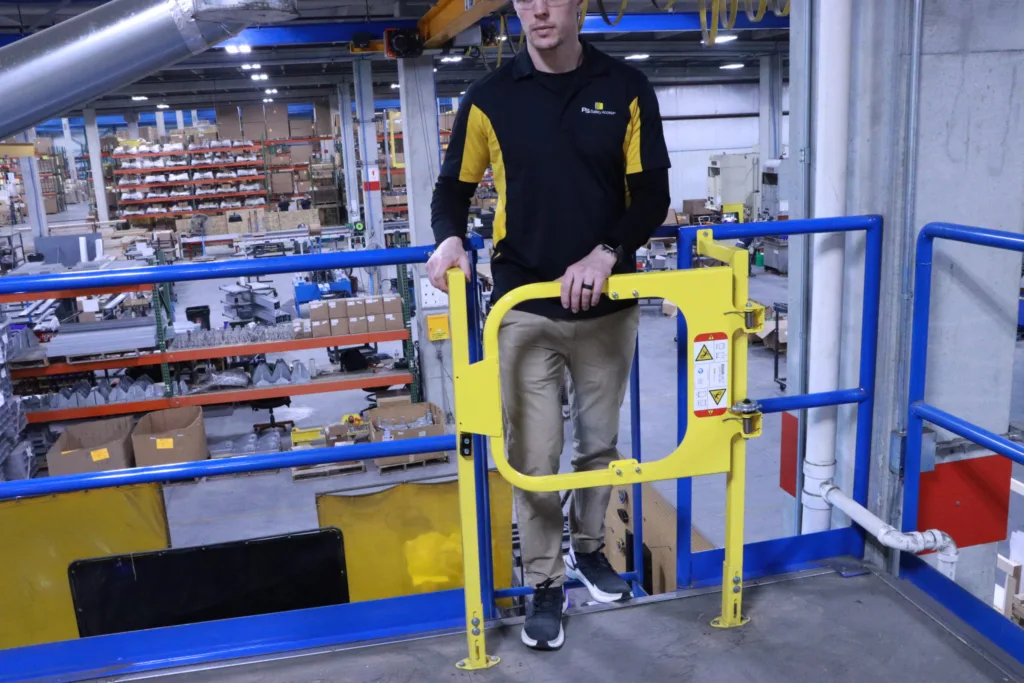
Effective fall protection must work seamlessly within fast-moving industrial environments. That’s why more and more facilities are turning to EdgeHalt® Ladder Safety Gates from PS Safety Access®.
Designed specifically for industrial ladderways, mezzanines and elevated platforms, EdgeHalt Ladder Safety Gates provide OSHA- and ANSI-compliant fall protection while maintaining smooth employee movement throughout the facility. These self-closing safety gates automatically return to the closed position after each use, helping ensure that ladder openings remain protected without depending on workers to manually secure the area.
EdgeHalt gates provide a permanent and reliable safety solution engineered for demanding industrial conditions. They feature Slam-Proof® technology that ensures reliable, quiet operation, and their rugged construction is designed to withstand high-traffic manufacturing environments while maintaining long-term performance and compliance.
To learn more about EdgeHalt Ladder Safety Gates, go to www.pssafetyaccess.com/edgehalt-ladder-safety-gates/.
Works Cited
- OSHA. “29 CFR 1910.29 – Fall Protection Systems and Falling Object Protection.” Occupational Safety and Health Administration. https://www.osha.gov/laws-regs/regulations/standardnumber/1910/1910.29
- OSHA. “29 CFR 1926.1053 – Ladders.” Occupational Safety and Health Administration. https://www.osha.gov/laws-regs/regulations/standardnumber/1926/1926.1053
- OSHA. “Standard Interpretation Letter – Ladderway Openings.” January 15, 1993. https://www.osha.gov/laws-regs/standardinterpretations/1993-01-15
- O’Keeffe’s Inc. “ANSI A14.3-2008: A Comprehensive Standard for Fixed Ladders.” https://okeeffes.com/ansi-a14-3-2008-a-comprehensive-standard-for-fixed-ladders/